Ask anyone to name one knife and the answer is usually a Bowie. It shows up in westerns, in Crocodile Dundee, in the Rambo movies, and after nearly two hundred years it is still the first thing most people picture when they hear the words fighting knife. I have spent my career forging, handling, and selling custom knives, and no pattern comes across my table more often than this one. The real history is messier than the movies, and more interesting. Here it is, as well as the record can tell it.
What Is a Bowie Knife?
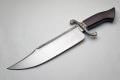
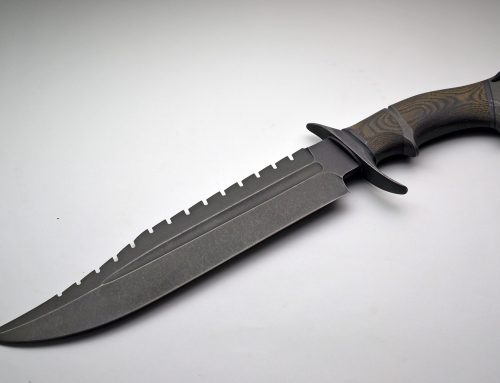
A Bowie is a large fixed blade fighting knife, most often with a clip point. The clip is the section of the spine near the tip that is cut away, sometimes in a straight line and sometimes in a concave sweep, and on many Bowies that false edge is sharpened. Add a crossguard to protect the hand and a blade that usually runs somewhere between six and twelve inches, and you have the basic recipe.
Here is the part that surprises people: there has never been one official specification. In James Bowie’s own day the word covered a whole family of big fighting knives, and it still does. What makes a Bowie a Bowie is less a blueprint and more a purpose. It is a large, well balanced blade a man could trust his life to, equally ready to cut, chop, or thrust. When I judge one today, balance is the first thing I check, because a big knife that fights the hand fails the whole point of the pattern.
Who Was the Bowie Knife Named After?
The knife takes its name from James Bowie, a Louisiana land speculator, brawler, and eventually a defender of the Alamo. The design, though, was probably not his. His brother Rezin Bowie claimed credit for the first knife, and the earliest blade we can trace was forged by a blacksmith named Jesse Clift at Rezin’s request. That first knife looked more like a heavy butcher knife than anything on my table today. The blade ran about nine and a half inches long, a quarter inch thick, and an inch and a half wide, with a straight spine, no clip point, and no guard at all.
Rezin gave the knife to James for protection after James survived being shot in a feud. That detail matters, because the man who shot him, Major Norris Wright, would meet the knife again.
The Sandbar Fight
This is the event that made the man and the knife famous. On September 19, 1827, a formal duel was arranged on a wide sandbar in the Mississippi River near present day Vidalia, Louisiana. The spot was chosen because it sat outside the reach of local law and its anti-dueling statutes. The two principals, Samuel L. Wells III and Dr. Thomas H. Maddox, each fired twice, missed twice, and shook hands.
Then the seconds and supporters started a brawl. James Bowie was shot twice, stabbed repeatedly, and clubbed over the head, and he still killed Norris Wright with the big knife his brother had given him. He spent months recovering from two bullet wounds, seven stab wounds, and the beating. While he healed, the newspapers did the rest. The Sandbar Fight was reported across the country, and suddenly every man heading for the frontier wanted a knife like Bowie’s. Blacksmiths obliged, and the pattern spread faster than the facts.
James Black and the Question of Who Made It
The most famous claim in Bowie lore belongs to James Black, a blacksmith working in Washington, Arkansas. The story goes that around 1830 Black forged an improved knife for James Bowie, possibly adding the sharpened clip point we now consider the signature of the pattern. It is a good story, and it may even be true, but Black later went blind, never documented his method, and no knife that can be proven to be his survives. I tell collectors the same thing the record tells me: the origins are murky, the claims conflict, and anyone selling certainty about the first Bowie knife is selling something.
What we can prove is what happened next. By the 1830s and 1840s the cutlery firms of Sheffield, England were mass producing Bowie knives for the American market, many of them etched with frontier slogans, and shipping them across the Atlantic by the crate. An English factory knife made for Texas: that is how big the legend had already become.
The Alamo and the Legend
James Bowie died at the Alamo on March 6, 1836, too sick to stand by most accounts, and his death welded the man and the knife together permanently. Through the rest of the century the Bowie went everywhere the frontier went. Miners carried them through the gold fields, soldiers on both sides of the Civil War carried them, including the big D-guard versions, and several states wrote laws that named the Bowie knife specifically. Not many tools earn their own legislation.
The Bowie and the Modern Custom Knife
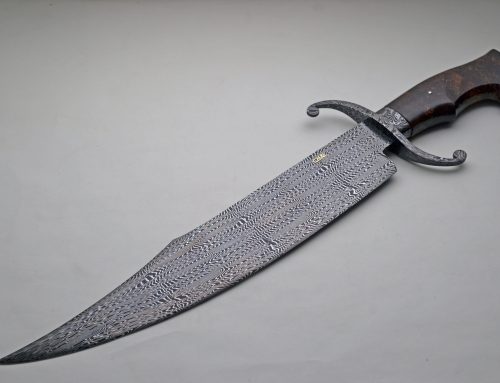
The Bowie pattern is also the backbone of the modern forged blade revival. When Bill Moran brought Damascus steel back and helped found the American Bladesmith Society, the Bowie became the proving ground. To earn a Journeyman or Master Smith rating from the ABS, a smith presents a forged blade that must cut free hanging rope, chop through construction lumber, still shave hair afterward, and then bend to ninety degrees without breaking. Most of us took that test with a Bowie style blade. I took it myself on the way to my own Master Smith rating, and I can tell you the pattern earns its reputation honestly. You can read more about Bill Moran and the founding of the ABS elsewhere on this site.
Today the Bowie is where many of the best makers in the world do their finest work. Fighters and Bowies from smiths like Ben Seward and Kyle Gahagan pass through my hands regularly, and a well made example is still exactly what it was in 1827: a big, honest blade, balanced to move, built to be trusted.
You can browse the Bowie knives currently for sale in my collection, or contact us with any questions at exquisiteknives@gmail.com or (760) 945-7177. Bowies from the top makers tend to sell quickly, so if a piece catches your eye, please call before ordering to be sure it is still available.
May 15, 2017