Dave Ellis and Bob Loveless
I knew Bob personally, and over the years I have sold more of his knives than anyone. Along with Ed Wormser, I was an executive producer of Robert Loveless: An American Legend, the 76 minute documentary about his life and work, directed by Jack Lucarelli and David Bartlett. The film was made with the makers, collectors and friends who knew him best, and it won six festival awards, including the Gold Remi for Best Documentary Feature at WorldFest Houston.
I am also California’s first ABS Master Smith, so I look at a Loveless the way a smith does: the grind, the taper of the tang, the fit of the scales. Everything on this page comes from those two things together, decades of handling his knives and helping tell his story on film.
Bob Loveless: The Life and Times
For the full story of his life, including his blade markings, the knife patterns collectors ask about and the awards he won, see the complete Bob Loveless biography on the site for the documentary Dave executive produced. What follows is the short version.
Loveless was born in the city of Warren, Ohio and grew up with his grandfather. Loveless stated that he would go deer hunting with his grandfather: this is perhaps the first time that his interest for knives was piqued. He saw a hunter pull out a jack knife to dress a dear: later, he would state that it was something that impressed him greatly.
After lying about his age and joining the merchant marine at the age of 14, he served in the merchant fleet until he was old enough to join the Air Corps. He then served as a tower operator on Iwo Jima and Guam. After witnessing many knife fights in the bars of the foreign port towns, his interest in knives was once again stirred. Loveless then had a brief stint at Chicago’s Armour Institute of Technology and returned to Ohio in 1951 to study sociology and literature at Kent State.
Bob Loveless: The Knifemaking Years
In 1953, Loveless again returned to the merchant marine and set course on a tanker based in New York. Learning that the Abercrombie & Fitch store in New York City sold Randall Made Knives, Loveless stopped in to purchase one; however, after learning that there was a nine month for the knife he desired, he decided to make his own knife and show it to the head of the Abercrombie & Fitch cutlery department. Loveless soon cut a deal with the retailer to sell his own knives, first based off of Randall’s design. With a $1000 bank loan secured, Loveless made over a thousand knives – called his “Delaware Maids – for Abercrombie & Fitch. He sold his knives to Abercrombie for a little over $14, with Abercrombie selling the knives at their store for $34.50 each. His knives soon became Fitch’s #1 selling handmade item.
By 1960, Bob Loveless stopped building knives based on Randall’s designs and began making his own. Loveless designed the full-tapered-tang method through his study of 19th-century knifemaking techniques; essentially, the entire piece of steel ran through the blade and the handle in contrast to more modern knifemaking techniques, which is to pin or glue the blade steel to the handle. This led to a stronger and more reliable knife design, placing the balance of the weight in the center of the knife.
Loveless went on to pioneer the use of 154CM steel and ATS-34 stainless steel for knife blades and the use of Micarta for knife handle material. Loveless was also a founding member of the Knifemaker’s Guild (founded 1970) and served as the first secretary; Loveless also served as the Guild’s president from 1973-76. Loveless has made knives for the US special forces and the CIA, pioneered the tactical knife, was Gerber Knives lead designer, and designed knives for other companies such as Beretta, Lone Wolf Knives, and Schrade Cutlery.
In 1985, Loveless was inducted into the Blade magazine Cutlery Hall of Fame.
Why collectors pay what they do for a Loveless
There are a handful of reasons a Loveless holds its value the way it does, and they compound.
- Provenance. Every Loveless knife traces directly back to one of the most important names in the history of the craft.
- He made them himself. Loveless worked at his own bench. Supply was always limited by what one man could finish, and a great many of his knives are now in private collections or museums and never come back on the market.
- The designs are his. He pioneered the tactical knife, popularised Micarta as a handle material worth putting on a collectible knife, and introduced 154CM and ATS-34 to American knifemaking. You are buying the original of designs other makers have been following ever since.
- He would not take orders. Loveless called himself a bench maker rather than a custom maker, because he built only his own patterns and let the buyer choose the handle material and nothing else. Every knife is his design, not a commission.
- A long record of appreciation. Prices for authentic Loveless knives have climbed steadily for decades, which is why they turn up in serious collections as much for the investment as the craft.
As a 1980 profile in Sports Illustrated put it, in the opinion of hunters, guides, collectors and fellow bladesmen, Loveless was the best knifemaker in the world.
How to tell an authentic Loveless knife
Because of what they are worth, Loveless knives get faked. These are the things to check, and if you are spending real money, buy from a dealer who will stand behind the knife.
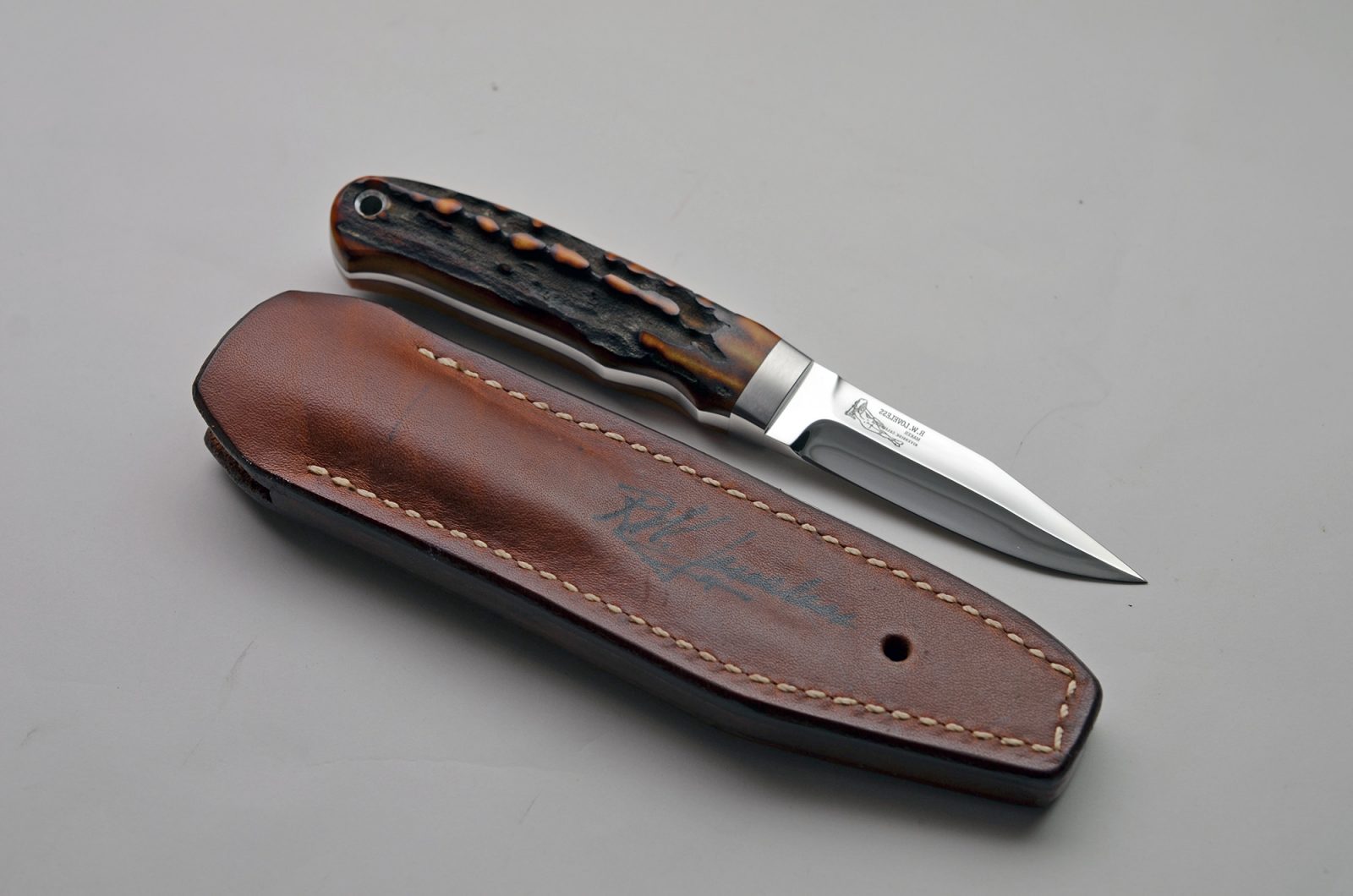
- The mark. Loveless blades are acid etched, never stamped, because stamping drives stress into finished steel. Look for R.W. LOVELESS, MAKER, RIVERSIDE, CALIFORNIA, or a Lawndale, California address on some knives. Many also carry the football logo or the reclining nude logo.
- The construction. The signatures are the hollow ground drop point, the fully tapered tang, and handle scales held with screw type fasteners rather than peened pins.
- The materials. Stainless steel, typically 154CM or ATS-34, with handles in stag, ivory or Micarta.
- The paperwork. Provenance matters more here than on almost any other maker. Ask what comes with the knife and who has owned it.
- Condition. A well kept used knife holds its value. Mint examples command the strongest prices.
Buy Bob Loveless Knives
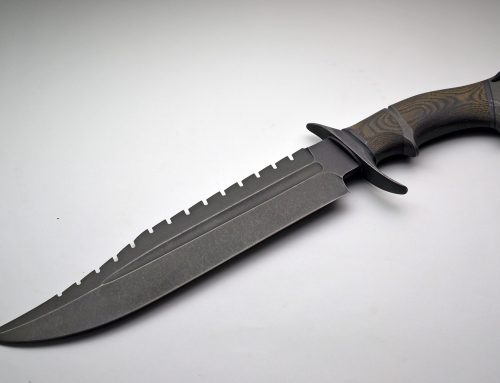
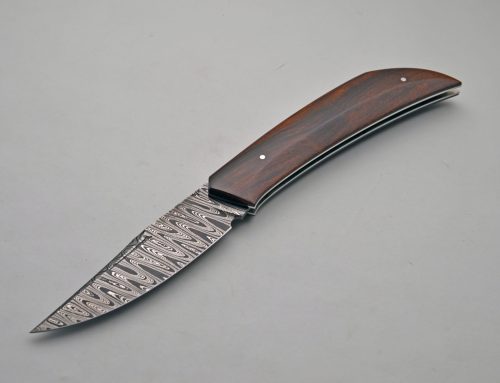
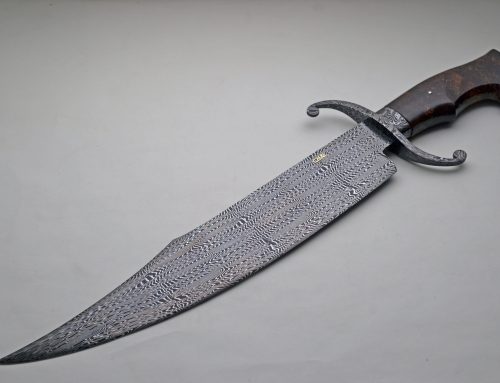
Authentic Loveless knives pass through the gallery regularly, and they sell quickly. Here is what is in stock right now:
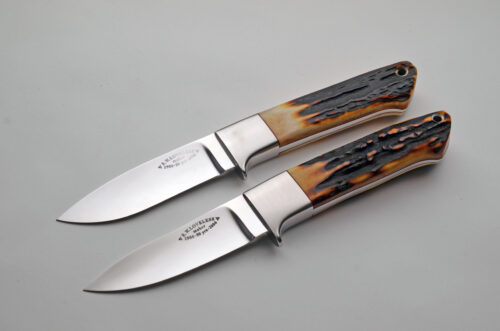
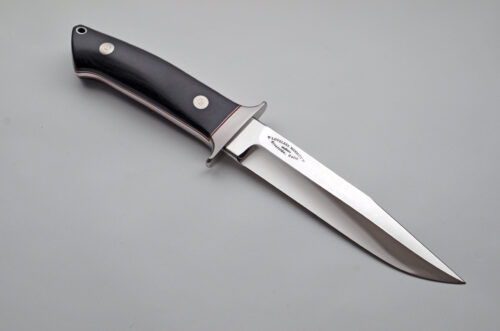
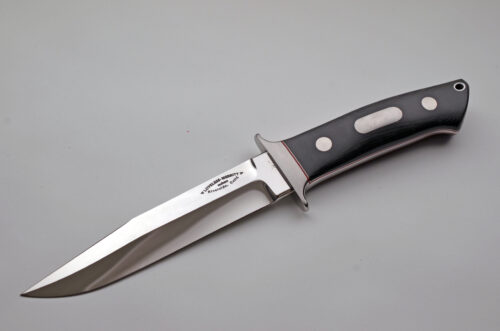
The current pieces are always in the Loveless knives for sale category, and you can also browse the custom knives currently for sale across the whole collection. Because Loveless pieces move fast, please call or email before ordering to confirm a knife is still available: (760) 945-7177 or exquisiteknives@gmail.com. If you are hunting for a particular pattern, tell me what it is. Many Loveless knives change hands privately and never reach the website.
May 1, 2019